Our Story
The information was in the system. Nobody connected it to me.
An inconclusive ultrasound. A follow-up that never happened. Months of avoidable chemotherapy. That gap isn't a rare failure — it's the default in healthcare, and it's the reason Proactives exists.
2021
A Missed Test
I was diagnosed with testicular cancer at 37. I'd had symptoms for months. An ultrasound was ordered — the radiologist wrote that the reading was inconclusive and recommended a follow-up in six weeks. Nobody called me. I was told everything was fine.
A simple blood test — cheap, widely available — would have made the reading conclusive. It wasn't ordered. By the time the cancer was caught, the delay meant months of additional chemotherapy that could have been avoided.
I was treated at Princess Margaret Cancer Centre in Toronto. The care was extraordinary. The delay was avoidable.
The Gap
Not a Rare Failure. The Default.
The note was in the system. The follow-up recommendation was in the system. The information existed; nobody connected it to me. That isn't an unusual failure — it's how healthcare works when information is fragmented across providers, portals, and paper. Diagnostic errors are among the most common and most costly categories of medical mistake: stroke alone is missed roughly 17% of the time[AHRQ 2022], and serious diagnostic harm in the US is concentrated in a short list of conditions including stroke, sepsis, pneumonia, venous thromboembolism, and lung cancer[Newman-Toker 2024]. What's less obvious is what to do about it from the patient's side.
At the population level, not ordering an extra test on a 37-year-old with vague symptoms is probably the "correct" protocol. Base rates are low; most cases resolve; testing everyone generates false positives. Guidelines optimized for ten thousand patients can be dead wrong for the individual in the exam room — especially when the test is cheap and the missed diagnosis is catastrophic.
Someone has to advocate for the individual when the population data says "probably not." That someone is you. The question is whether you have the tools. Read the screening evidence →
The Response
Why Every Answer Cites a Page
The experience of years of scattered records — across providers, portals, paper, and email — is what set the design constraint. If a tool was going to be useful in the moments that matter — the morning before an appointment, the late-night re-read — it had to do two things: structure the chaos, and show its work.
That's why Proactives Health takes scattered records — PDFs, photos, patient-portal screenshots — and organizes them across twenty clinical categories. And it's why every AI answer cites the exact page in the exact document it came from. No black box, no synthesis you can't verify. The point isn't to replace your doctor; it's to walk into the appointment as an informed participant.
Community
The Ride to Conquer Cancer
Team Proactives rides for Princess Margaret because research in immunotherapy, precision medicine, and early detection changes what is possible for future patients. The Ride to Conquer Cancer community has raised over $320 million for cancer research[Ride], and the Ride includes route options of over 200 km[Ride]. Join or support the team →
Founder
Jared Kalish
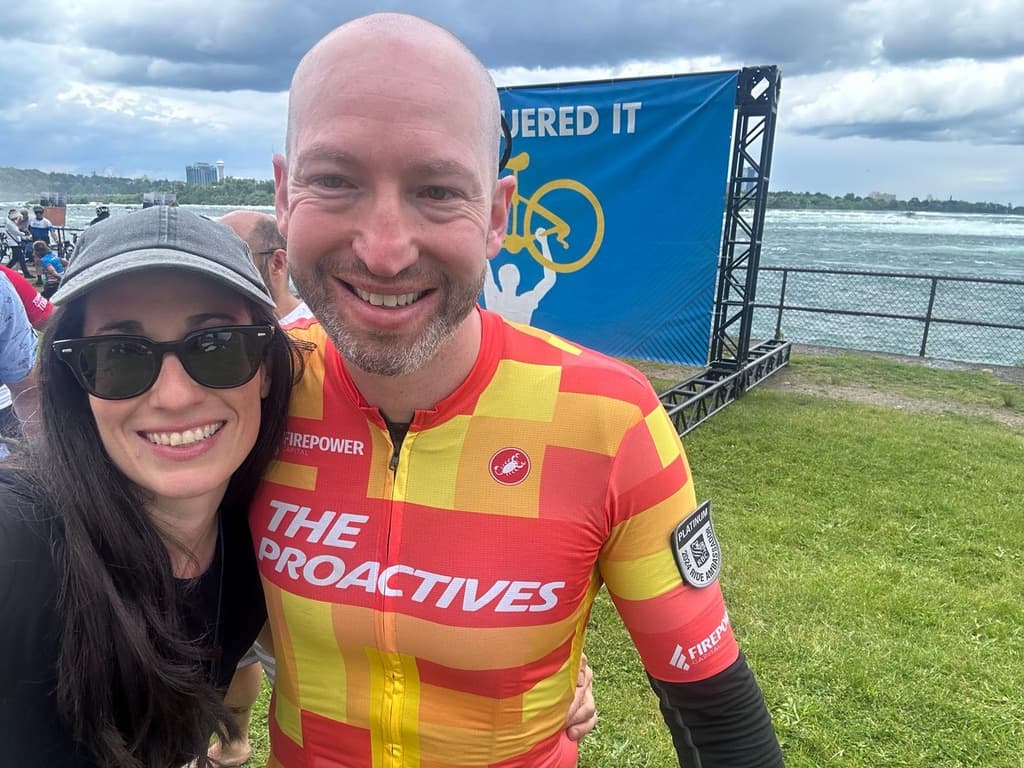
South African, based in Toronto since 2013. Background in statistics and risk (LSE), with a career in private capital and company building. Healthcare runs in the family — his wife founded HealthCasa, which delivers clinical services directly to patients across Canada.
See your records, finally in one place.
Upload what you have. Ask questions in plain English. Walk into your next appointment as an informed participant.